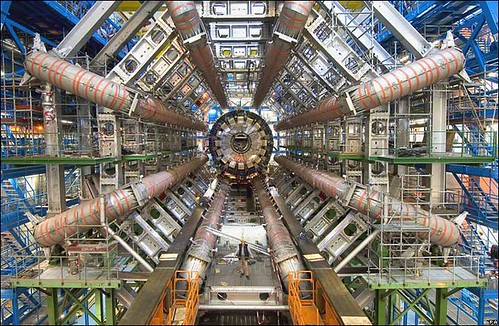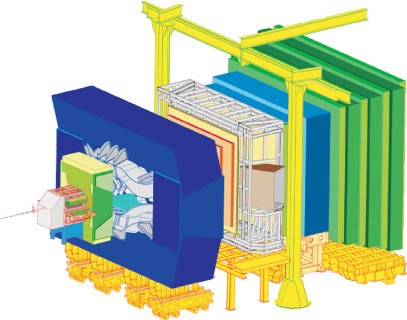
The Large Hadron Collider is the largest and most complex scientific instrument ever built and the highest energy particle accelerator in the world. The accelerator is located 100 m underground and runs through both French and Swiss territory.
Year 2008 marks the culmination of 20 years of work by physicists, engineers, technicians and support staff from over 80 different countrieIt is a particle accelerator used by physicists to study the smallest known particles – the fundamental building blocks of all things. It will revolutionise our understanding, from the minuscule world deep within atoms to the vastness of the Universe.
Two beams of subatomic particles called 'hadrons' – either protons or lead ions – will travel in opposite directions inside the circular accelerator, gaining energy with every lap. Physicists will use the LHC to recreate the conditions just after the Big Bang, by colliding the two beams head-on at very high energy. Teams of physicists from around the world will analyse the particles created in the collisions using special detectors in a number of experiments dedicated to the LHC. Studies include dark matter and antimatter.
There are many theories as to what will result from these collisions, but what's for sure is that a brave new world of physics will emerge from the new accelerator, as knowledge in particle physics goes on to describe the workings of the Universe.
Critics have contended that the machine could produce a black hole that could eat the Earth or something equally catastrophic.
To most physicists, this fear is more science fiction than science fact. At a recent open house weekend (May 2008), 73,000 visitors, without pitchforks or torches, toured the collider without incident.
Nevertheless, some experts say too much hype and not enough candor on the part of scientists about the promises and perils of what they do could boomerang into a public relations disaster for science, opening the door for charlatans and demagogues.