February 2008
My friend Yvonne once told me that it was only when she lived in my country's capital that she understood which city Nairobi was going to be when it grew up. Harare in the 1990s was funky and groovy and uncluttered and happening. Zimbabwe in the 1990s was a country in which people still dreamed and planned with the reasonable expectation that their dreams would come true, and if they didn't, they could downgrade them to less ambitious, but still acceptable versions. There was a flow of tourist money, there were film festivals, and arts festivals, there were world-class Manchurian restaurants and people speaking of all the things they planned. There were about 20 foreign airlines bringing the world to us. Now there are only four. Yvonne's words are always with me when I think about my home city, because when I think about her home city, I see the city that Harare could have been, and in Kenya, the country mine could have been.
I once lived in a European city that had so few black people that I was most people's only encounter with Africa. I was the Africa expert, giving little seminars on the genocide in Rwanda and the promises of South Africa's rainbow nation. Throughout that time, I felt like a poser – the one African country that I really knew was Zimbabwe, the rest were as foreign to me as Slovenia or Poland. I still feel I do not know Africa. I never can, but through reading, travel and friendships, I have come to love a number of African countries.
More than these, I love Kenya.
Kenya means very specific things to me. It means my friends at Kwani?, the hip literary journal which has opened a space in which the most moving and funny and lacerating and edgy writing is exploding out into the world. I cannot separate their kwaniness from their Kenyanness. Kenya means Lamu, a place like no other that I have visited. Kenya means all the amazing people that I have met in my travels there, filmmakers, and businesswomen, civil servants, media types, hotel staff, for I have stayed mainly in hotels, so that I am one of those for whom Kenya will always be the country of the permanent karibu, a county of the friendliest people in the world, an eye-rolling cliché that is nonetheless true. I have conversed with Luo and Kalenjin and Kikuyu and, on one occasion, what I took to be Massai teenagers, but who, according to my Kenyan companions, were Kikuyu dressed as Massai for the tourist dollars. On a beach in Mombasa, I cemented my Kenyan tourist credentials: I received the flattering attentions of a reed-thin "beach boy" with beaded dreadlocks.
To add to these associations with the people I have met are all the wonderful things that happened to me in Kenya. The thrill of my first ever public reading as a writer. The young men who asked me if I had ever visited Kibera because the slum I described in my reading sounded like their home. The ground of Kenya shaking beneath my feet as I fell in love on the shores of Crater Lake.
Every time that I have been to Nairobi, I have returned with a singing soul.
And when I am not there, Kenya follows me. The smiling man I met on the Number 8 bus to the United Nations is a Kenyan, he said. I swelled with pride when Kenya's Ambassador Amina Mohammed became the first African to chair the WTO's General Council, and the first African woman to be interviewed for a spot on the WTO's Appellate Body. Whenever I met Kenyans in Geneva and other places, I felt a strong tug of kinship. And at school, my four-year-old son Kush became best friends with a little Kenyan boy called Jacob.
Like Juliet did to the love-struck Romeo in the Dire Straits song, Kenya exploded on my heart.
There was an underlying ache.
I wished we had this in Zimbabwe, that a rainbow coalition of political parties could unseat a stagnant ruling party and still have a vibrant opposition. I could not help comparing Nairobi's greenness to Harare's drought dry grasses and trees. A friend once asked me what I thought we would talk about in Zimbabwe if ever we solved our crisis. In Kenya, I found some answers. Kenyans filled the streets of Nairobi at the weekend, their bars were packed with smiling happy people, troubled, it seemed to me, by no graver political issues than the antics of their health minister Charity Ngilu. On one weekend that I was in Nairobi, the papers were given over to a discussion of the school results. There were league tables, and pictures of beaming little girls and boys and agonising editorials about why some regions were doing badly compared to others. I remember a picture of a woman with a smile that showed the insides of her teeth as she embraced her son.
Future doctor, said the caption.
For one used to headlines from the Zimbabweans papers about inflation going up to 15 000%, and newspapers filled with the President's daily screeds against "detractors and would-be colonisers" and the empty promise that Zimbabwe would never be a colony again, this all seemed achingly normal.
Then came December 2007.
And suddenly, it was not of Zimbabwe that stern-faced British prime ministers, European Union observers and American presidents were talking, but Kenya. Suddenly, Nairobi was becoming Harare, and Kenya, Zimbabwe.
Source
Showing posts with label Zimbabwe. Show all posts
Wednesday, October 13, 2010
Thursday, September 16, 2010
Inflation (2008)

2 min. Short feature
Inflation traces the birth, life and death of a Zimbabwean $10,000 note as the economy goes up in smoke.
Wednesday, September 15, 2010
The Visitor (film)

This film, that was written and directed by actor Tom McCarthy, tries to give the hot political issue of illegal immmigration a human face. Tarek (Danai Gurira)and Zainab (Haaz Sleiman) rent a flat in Manhattan and are shocked when Walter Vale (Richard Jenkins) comes to claim it as his own. It soon becomes obvious that the couple are victims of an unscrupulous real estate connection of theirs. Walter eventually, reluctantly, allows them to stay on with him. This leads to some cross-cultural bonding. Walter learns how to be a djembe drummer from Tarek. It all goes well until Tarek is arrested on a misunderstanding and is so discovered to be an illegal immigrant. Walter makes some radical life changes as he attempts to help his friend. The arrival of Mouna, Tarek's mother (Hiam Abass) in search of her son fans some romantic flames. The Visitor has the cliches that are usually attendant to similar tales but manages to win the heart of the viewer.
Read more at Suite101: ZIFF 2008 Opening Night: Zimbabwe International Film Festival 2008 Starts on a Good Note http://www.suite101.com/content/ziff-2008-opening-night-a67481#ixzz0zboJTRsU
Zimbabwe (film)

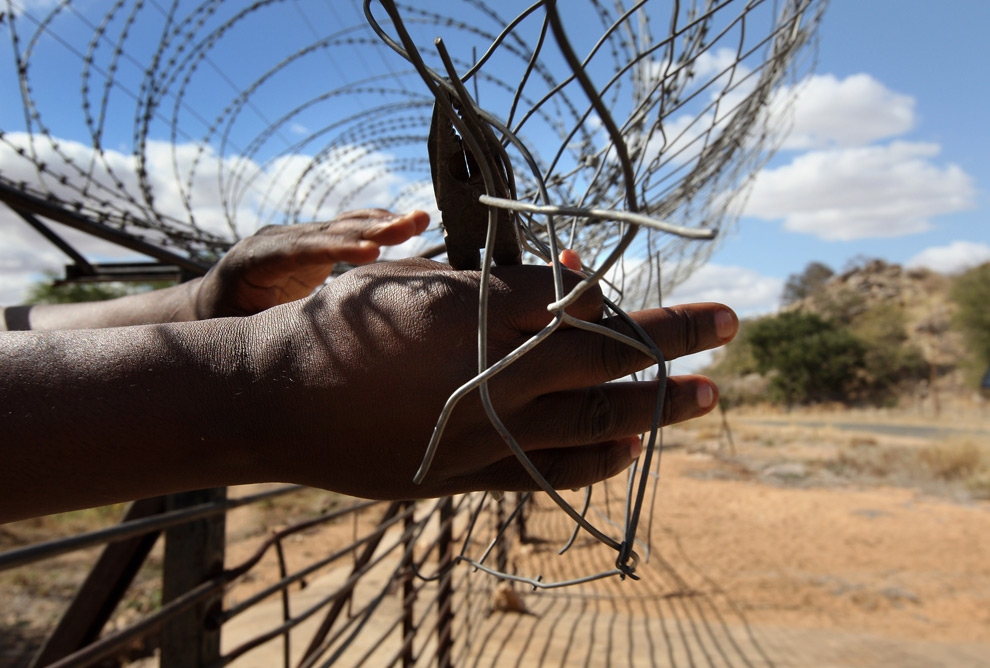
every day, 1000 people illegally cross the border between Zimbabwe and South Africa. Zimbabwe, the central character in the film whose patriotic name was bestowed upon her by her father in honour of the independence of the country, decides to jump the border and emigrate illegally to South Africa. The film chronicles her life as an undocumented domestic and the cyclical process of poverty, emigration, and violence.
Released 2008
Labels:
film,
Immigration,
South Africa,
violence,
Xenophobia,
Zimbabwe
Famine and the GM Debate

Amid the efforts to cope with a famine threatening 30 million people, a row is raging over genetically modified (GM) food aid. Zambian president Levy Mwanawasa refused GM food aid calling it "poison". Zambia, Zimbabwe, Mozambique, and Malawi are concerned that letting in food aid containing genetically modified material will lead to the planting of seeds and the contamination of domestic crops. Angola, Lesotho and Swaziland have not adopted positions on GM but have not refused aid containing genetically modified food.
Labels:
Aid,
Angola,
Genetically Modified,
Lesotho,
Malawi,
Mozambique,
Swaziland,
Zambia,
Zimbabwe
The Ghost of Dollarization in Zimbabwe

Dollarization, the holding by residents of a significant share of their assets in the form of foreign currency-denominated assets, is a common feature of developing countries and some transitional economies. This phenomenon is also typical of many countries that have IMF-supported adjustment programmes. But as Zimbabwe’s dollarization experience has shown, dollarization can, and does occur, when the "flight from domestic currency" gets under way. Such broad conversion into hard currency actually can accelerate inflation, as people jettison their money at ever-faster rates.
Chronic inflation does not necessarily degenerate into hyperinflation. But in the five countries, preceding Zimbabwe, it did ensue, triggered by an uncontrolled expansion in the money supply that was fueled by endemic fiscal imbalances.
Tuesday, September 14, 2010
The Murder of Tonderai Ndira

Tonderai Ndira (1975 or 1976 – between May 13 and May 22 2008) was a Zimbabwean political dissident murdered in May 2008.
Ndira lived in Mabvuku, Zimbabwe, and was an "prominent activist" member of the Movement for Democratic Change. He was described by a human rights campaigner as "a youth activist who went around the country holding workshops and teaching people their rights".
He was arrested on thirty-five occasions, and was reportedly described by his followers as "Zimbabwe's Steve Biko".
Zimbabwe: Using New Technologies to Fight for Democracy

In countries such as Zimbabwe where media freedom is extremely restricted, new technologies have become powerful tools for political campaigning, communication, advocacy and mobilisation. Since Robert Mugabe turned the country into a dictatorship, bloggers and civic organisations have resorted to using new tools and applications such as blogs, Flickr, Facebook, SMS, YouTube and mashups to fight for democracy, media freedom and good governance.
Why South Africa will never be like Zimbabwe

Jeremy Cronin
In this Chris Hani Memorial Lecture, Jeremy Cronin traces the differences between the ANC and Zanu-PF as liberation movements and as parties in power.
Monday, September 13, 2010
Dinner with Mugabe

Heidi Holland
This penetrating, timely portrait of Robert Mugabe is the psychobiography of a man whose once-brilliant career has ruined Zimbabwe and cast shame on the African continent. Heidi Holland’s tireless investigation begins with her having dinner with Mugabe, the freedom fighter, and ends in a searching interview with Zimbabwe’s president more than 30 years later. The author charts Mugabe’s gradual self-destruction, and uncovers the complicity of some of the most respectable international players in the Zimbabwe tragedy. Probing the mystery of Africa’s loyalty to one of its worst dictators, Holland explores the contradictions that cloud the life of a man who had embodied the continent’s promise.
Hardcover, 250 pages, April 2008
Published by Penguin Books South Africa
ISBN-13: 978-0-14-302557-3
Subscribe to:
Posts (Atom)