Lit prizes as sport
"Snubbed again - I can't understand why I have been overlooked. The judges for the Booker Prize have been announced and, yet again, I am not on the list. Don't they know I have credentials second to none entitling me to be added to this prestigious gathering? Haven't I been betting on it for the best part of twenty years? Aren't I invariably the only person outside of the actual judges at the Guildhall each year to have read all of the books and not just skimmed through the fly-leaves to pick up a feel for the book? Aren't I interviewed by whichever TV station happens to be covering the event this year and asked for my tip every year? Don't the papers clamour for my opinion?
Of course I am - of course they do - yet that elusive invitation remains just a dream. I am treated as though I were a judge, though. One national newspaper reviewer rang me a few weeks back asking me to quote odds for his hot tip to win the Booker Prize this year. I told him that was like telling me Red Rum was in the Grand National but not telling me who he was running against. I did take the precaution of getting hold of the book he fancied and reading it. The book is a decent enough read and packs in plenty of references to the seventies, although many of them seem to be inserted just to prove how well the author's done his research. Should get nominated but is probably too readable to win!
See, I can be controversial - which is always a good trait for a Booker judge - the Award doesn't really warm up each year until someone comes out with some outrageous comment which gets plenty of publicity and stimulates the betting market. Because, of course, the majority of people who bet on the Award do so not because they have read all the books, but because they are following a reviewer's hint or someone told them that they read one of the books and it was unputdownable - or, in some cases, incomprehensible."
Ladbroke (taking bets on the Nobel Prize, Man Booker, and others since 1987)
William Hill
Get someone to give odds on the '08 Caine Prize or one of the other African lit prizes
Showing posts with label Prize winners. Show all posts
Monday, October 11, 2010
Thursday, September 16, 2010
Une Affaire De Negres (Black Business)

It is estimated that during a single year - 2000 - over 1,000 Cameroonians were killed by the Operational Command Unit, a special group of trained operatives, created by the President of the Republic of Cameroon, to tackle rampant banditry in the region of Douala. This, international commentators suspect, is merely a fraction of a far larger number of 'disappearances', over the preceding few years. Award-winning filmmaker Osvalde Lewat-Hallade's latest documentary is about the Cameroonian families, who have lost loved ones to the terrifying Unit.
2007 (2008 Cannes Cinema of the South and International Festivals)
French, Bamileke dialogue with English subtitles 90 mins
Labels:
Cameroon,
crime,
documentaries,
film,
Prize winners,
violence,
war machines
Wednesday, September 15, 2010
Jerusalema and Depictions of African Cities in Film
Excerpt from Don Mattera’s NFVF review:
“In Jerusalema, the Hollywood spectre almost consumes the narrative of South Africa’s urban cities... The ’foreign’ characters receive fleeting stereotypical treatment – just like some photographs on a wall; no origins, no history; no soul; just money, drugs, women bloodshed and death.”
http://www.nfvf.co.za/content/jerusalema-south-africas-new-oscar-hope-review
“In Jerusalema, the Hollywood spectre almost consumes the narrative of South Africa’s urban cities... The ’foreign’ characters receive fleeting stereotypical treatment – just like some photographs on a wall; no origins, no history; no soul; just money, drugs, women bloodshed and death.”
http://www.nfvf.co.za/content/jerusalema-south-africas-new-oscar-hope-review
Labels:
Cities,
Definite Film Stories,
Definite Stories,
film,
Johannesburg,
Prize winners,
South Africa,
urbanism
Triomf wins Best South African Feature Film at DIFF

Directed by Michael Raeburn
…”by immersing itself into the often sordid world where poverty, and the educational gaps that attend it, meet an arrogant sense of entitlement, Triomf exposes a series of universal truths. The dirty secrets of capitalism, of racism, of manipulative politics, of the human heart are mirrored in the secrets of one family, whose disintegration reminds us that a nation's history is written by individuals”
Tuesday, September 14, 2010
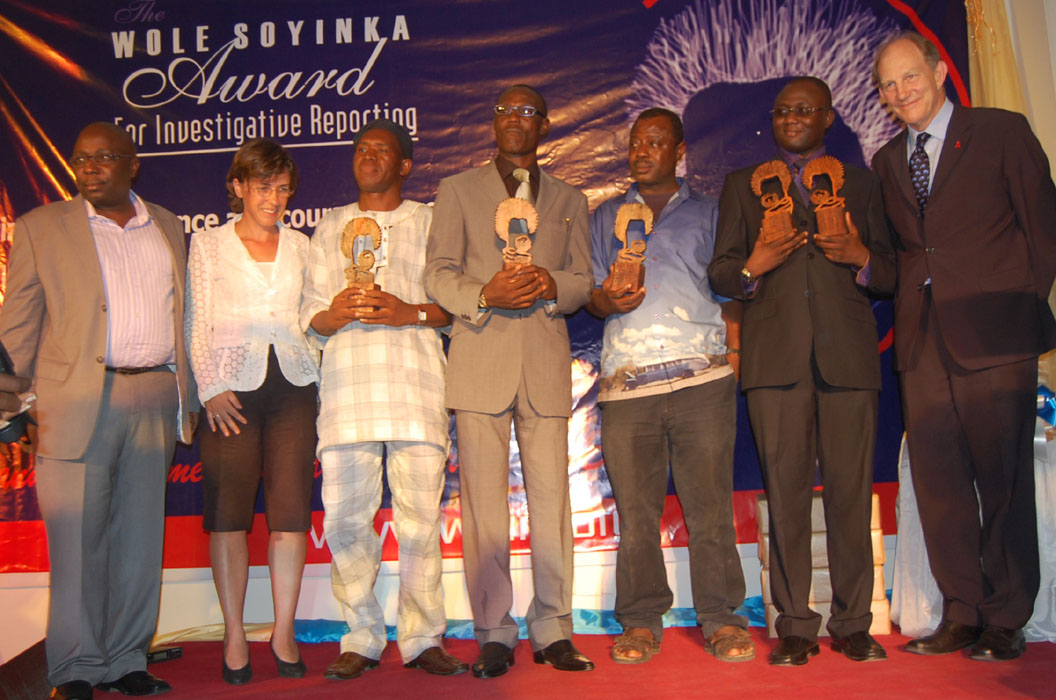
Wole Soyinka Awards for Investigative Journalism (May 2008)

The winning entry in the prints category is a series of stories on Iyabo Obasanjo, whose name keeps coming up like the proverbial bad coin in corruption cases. The series of stories were written by Mr Muraina Olufunso of ThisDay newspapers. The prize for the photo journalism category went to an entry from Mr Ademola AKinlabi of Tell. In the radio broadcast category, the prize went to Mr Solomon Adebayo reporter with the Federal Radio Corporation of Nigeria, Abuja, who did a story on the Abuja Environmental Protection Agency and hawkers in Abuja. The series of reports he did showed depressing levels of corruption in the Environmental Protection Agency, even up to the point that some workers in the agency kept private, illegal detention centres to hold hawkers who refuse to bribe them. The report led to the intervention of the police force, the release of the detainees and the arrest of the officials. It was even more impressive that the entry was from the state-owned radio network.
The winning TV entry, which was also the overall winning entry, is from Mr Deji Badmus of Channels Television. The report was on the Police Equipment Fund. It showed different layers of corruption, layers too nuanced to write about in this short space. Suffice it to say that the report was really impressive, in the coverage of the issue, and in the presentation of the efforts of the reporter and results of the investigation.
The Hangman’s Game

Karen King-Aribisala is an exceptional talent. She won the Commonwealth Prize (African Region) for the Best First Book in 1990 for Our Wife and Other Stories, and the 2008 Commonwealth Prize (Africa region) for the Best Book for The Hangman’s Game an affecting novel, which observes parallels in the slavery imposed by General Sani Abacha’s military regime in the 1980s and the conditions that led to the Demarara slave revolt in 1823. When a young Guyanese woman sets out to write a historical novel based on the Demerara Slave Rebellion of 1823, she is beset by questions about her own African roots. To free her writer's block, she travels to Nigeria to experience her origins first-hand, and she soon finds herself brutally plunged into a world where the distinctions between her life and her fiction are blurred. Rich in tension, dark humor, and striking characters, this densely layered work offers an unparalleled look into the complex history of past and present Guyana, as well as the nature of postcolonial power in both Africa and the Caribbean. “In the book, Nigerians are as enslaved as are the blacks in Demarara. There is a connection between the hanging of the narrator’s friend (a Ken Saro-Wiwa-like figure) by Sani Abacha and the hanging of the missionary, John Smith, who went to Demarara. “Also, Jesus was hung on the cross.” said King. - Maureen Isaacson
Common Wealth Prize

12 to 18 May 2008 as part of the Franschhoek Literary Festival.
Africa
The Hangman's Game – Karen King-Aribisala (Nigeria)
Peepal Tree Press
Imagine this – Sade Adeniran (Nigeria), SW Books
Canada and the Caribbean
The Book of Negroes – Lawrence Hill (Canada), HarperCollins Publishers
The End of the Alphabet – C.S.Richardson (Canada), Doubleday
Europe and South Asia
Animal's People – Indra Sinha (India), Simon and Schuster
A Golden Age – Tahmima Anam (Bangladesh), John Murray
South East Asia and South Pacific
The Time We Have Taken – Steven Carroll (Australia), HarperCollins
The Anatomy of Wings – Karen Foxlee (Australia), University of Queensland Press
Overall winners
* Best Book: The Book of Negroes by Lawrence Hill (Canada)
* Best First Book: A Golden Age by Tahmima Anam (Bangladesh)
Subscribe to:
Comments (Atom)