Showing posts with label Football. Show all posts
Thursday, December 2, 2010
Wikileaks targets FIFA
December 2, 2010
By Peter Alegi
In a few hours WikiLeaks will release thousands of secret FIFA documents detailing World Cup match fixing and widespread corruption within football’s governing body.
Never before have such confidential documents been released into the public domain. The documents will give people around the world an unprecedented insight into FIFA’s activities on the shores of Lake Zurich.
The documents, which date from 1998 to 2010, contain 15,652 confidential communications between FIFA executive committee members in Zurich and corporate sponsors, media networks, and other football officials throughout the world.
(via Africaisacountry via Football is Coming Home)
- docs from 2008 can be a resource for FIFA/football related stories
Wednesday, November 24, 2010
Egypt's Football Dominance
Before 1981 only two North African teams had ever won the African Champion's League title - Egypt's al-Ismaily in 1969, and Algeria's MC Alger in 1976. Since then, North Africa's teams have dominated the championship, winning the title on no fewer than 22 out of the last 28 tournaments. In 2008 Egypt took the Africa Cup of Nations, Cairo's al-Ahly won the Champion's League title for a record sixth time, and Egypt's Mohamed Abou Treika was named the BBC African Footballer of the Year.
What happened in 1981, and how did Egypt come to dominate African football?
Possible writer - football journalist Mohammed Ali
Labels:
Definite Sport,
Definite Stories,
Egypt,
Football
Monday, November 8, 2010
Arizona project 2010: killing soccer in Africa

FAIR Report: An ‘Arizona project’ in Africa
‘Killing soccer in Africa’ is the first Arizona project ever conducted on the African continent. In the Global Investigative Journalism Network, the label ‘Arizona project’ is extended to a team investigation into a story that has led to the harassment, injury, or death, of the individual reporter who first pursued the story alone. It is derived from an investigation that took place in the US state of Arizona, that got reporter Don Bolles killed in 1976. The assassination, by criminals intent on stopping Bolles from pursuing the investigation, led to a call by FAIR’s US sister organization, Investigative Reporters and Editors, to its members, to all descend on Arizona and finish the story. Thirty-eight reporters, working for over twenty media houses, responded to the call, followed the story, and published. The impact of the original story, that Bolles’ killers had wanted to silence, increased massively. Since then, the title of ‘Arizona project’ is given to efforts by a team of journalists coming to finish a story that a lone journalist has been stopped from pursuing by force.
The point that ‘you can stop a journalist, but you can not kill the story’ has, in 2010, been made in Africa by FAIR. When a journalist in Cameroon was severely beaten after he started probing the financial affairs of (Cameroonian) Confederation of African Soccer President Issa Hayatou, FAIR decided to carry out a Transnational Investigation to not only investigate Cameroonian soccer, but African soccer administration, the reign of Hayatou, as a whole. In total eight African countries, including five of the six countries that participated in the just ended World Cup, were covered.
This report resulted. Its conclusions are based on hard facts and cannot be dismissed: African soccer will not achieve meaningful results until its administrators are reigned in and held accountable for their high-living, wasteful and destructive management style. Maybe most importantly, this investigation shows that African soccer administrators are not the only culprits. The international soccer body FIFA is shown to protect and even promote bad African soccer managers. The report has so far been published by media in all the eight African countries where individual journalists participated in FAIR’s Arizona team. It has been reviewed by radio and online media internationally and FAIR hopes that the release of the entire dossier will incur even more international publicity.
This would after all be in line with the Arizona motto:
You can stop a journalist, but you can’t kill the story.
FAIR investigative team
Olukayode Thomas (Nigeria and Ghana)
Chief Bisong Etahoben and Franklin Sone Bayen
(Cameroon)
Dumisani Ndlela (Zimbabwe and Zambia)
Eric Mwamba (Ivory Coast)
Ken Opala (Kenya)
Phathisani Moyo (South Africa)
Charles Rukuni (Editor)
Full report here
Tuesday, October 12, 2010
Writer: Ashwin Desai
Author of The Race to Transform: Sport in Post-Apartheid South Africa
"Post-apartheid South Africa put great stock in the potential of sport to break down racial barriers and build a united nation. The 1995 Rugby World Cup victory, and Nelson Mandela’s now-famous appearance in a Springbok jersey, seemed perfect catalysts for the dream of a “rainbow nation”.
In The Race to Transform, editor Ashwin Desai and eight other authors examine elements of change in a number of sports arenas including swimming, athletics, rugby, soccer and cricket.
With kick-off to the FIFA 2010 Football World Cup mere weeks away, this timely book takes stock of sport in South Africa, and provides a pioneering exploration of how sport reflects matters such as enduring inequality, racial transformation and the making (or otherwise) of a common South African destiny. Divided into chapters delving into a diverse set of sporting codes, the book enlivens and transcends the technical debates and contestations around transformation that have become such a prominent part of sports discourse. The book places an emphasis on how South Africa’s transition has impacted on township sport. Moreover, it provides a view on the relationship between elite and grassroots sport in the context of growing economic disparities.
"Post-apartheid South Africa put great stock in the potential of sport to break down racial barriers and build a united nation. The 1995 Rugby World Cup victory, and Nelson Mandela’s now-famous appearance in a Springbok jersey, seemed perfect catalysts for the dream of a “rainbow nation”.
In The Race to Transform, editor Ashwin Desai and eight other authors examine elements of change in a number of sports arenas including swimming, athletics, rugby, soccer and cricket.
With kick-off to the FIFA 2010 Football World Cup mere weeks away, this timely book takes stock of sport in South Africa, and provides a pioneering exploration of how sport reflects matters such as enduring inequality, racial transformation and the making (or otherwise) of a common South African destiny. Divided into chapters delving into a diverse set of sporting codes, the book enlivens and transcends the technical debates and contestations around transformation that have become such a prominent part of sports discourse. The book places an emphasis on how South Africa’s transition has impacted on township sport. Moreover, it provides a view on the relationship between elite and grassroots sport in the context of growing economic disparities.
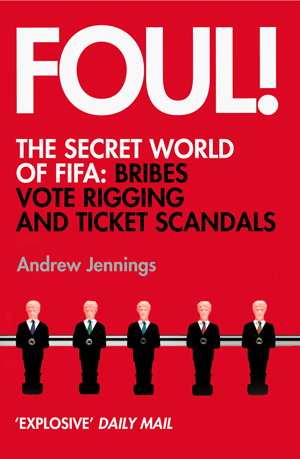
Writer: Andrew Jennings
Author of Foul! The Secret World of FIFA: Bribes, Vote rigging and Ticket Scandals"FOUL! is the result of seven year's research into the dark depths of the men controlling the world's favourite game. It charts the degeneration of FIFA under the leadership of Joao Havelange and Sepp Blatter.
It reveals the vote-rigging that put Blatter in power and the cronyism and ticket rackets that keep him there. And in the background ... the relentless flow of kickbacks to selected officials in return for billion-dollar contracts.
In a sensational interview for the new and updated paperback edition an executive involved in paying the bribes reveals how the money was laundered, at regular intervals, through off-shore bank accounts.
Another chapter digs deeper into FIFA vice-president Jack Warner’s vast World Cup ticket racket. And there’s new disclosures about the disastrous decision by FIFA to lie to MasterCard and VISA, forge a signature on a backdated contract and crudely edit a tape of a FIFA committee meeting, hoping to fool a New York judge."
Publisher: Harper Collins Publ. UK (April 30, 2007)
ISBN-10: 0007208693
ISBN-13: 978-0007208692
Tuesday, September 14, 2010
The Boys from Brazil

4 May 2008
To millions of fans around the world, they were, quite simply, the greatest group of players ever assembled. And when Paul Joseph set out to track down every member of Brazil's 1970 World Cup team, it was to become the 40,000-mile adventure of a lifetime.
A symposium on the technical aspects of the 2008 Africa Cup

A symposium on the technical aspects of the 2008 Africa Cup of Nations in Ghana was held in Cairo to evaluate what happened. The objective of the star-filled workshop was to review the 26th Africa Cup of Nations in Ghana and also identify key challenges in the pursuit of developing African football.
Published in Cairo by AL-AHRAM established in 1875 1 - 7 May 2008 Issue No. 895
Labels:
Africa Cup of Nations,
Cairo,
Definite Sport,
Definite Stories,
Football,
Ghana,
Sports
“Negros x Brancos” (Blacks against whites) in Brazil

manipulating color and race in Brazil
Luiz Schwarcz, who was beginning to build the company he had founded, Companhia das Letras, into one of the finest publishing houses in Latin America.
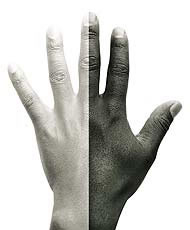
“In Brazil, you are what you describe yourself to be. Officially we have five different colors—black, white, yellow, indigenous, and pardo (meaning “brown,” “brownish,” or “gray-brown”), but in reality, as research has demonstrated, we have more than 130 colors. Brazilians like to describe their spectrum of colors as a rainbow and we also think that color is a flexible way of categorizing people. For several years, I have been studying a soccer game called “Pretos X Brancos” (Blacks against whites), which takes place in a favela of São Paulo, called Heliópolis. In theory, it pits eleven white players against eleven black players. But, every year they change colors like they change socks or shirts—one year a player will choose to play for one team,the next year for the other, with the explanation that, “I feel more black,” or “I feel more white.” Also, in Brazil, if a person gets rich, he gets whiter. I recently talked with a dentist in Minas Gerais. As he is becoming old, his hair has turned white, and he is very well recognized in his little town. He started smoking cigars, joined the local Rotary Club, and said to me: “When I was black my life was really difficult.” So one can see how being white even nowadays is a powerful symbol. Here we have two sides of the same picture: on the one hand, identity is flexible; on the other hand, whiteness is ultimately what some people aspire to. But one aspect is common, the idea that you can manipulate your color and race.
2008 AFRICA CUP OF NATIONS

Cairo, Egypt: A symposium on the technical aspects of the 2008 Africa Cup of Nations in Ghana was held in Cairo in May to evaluate what happened. The objective of the star-filled workshop was to review the 26th Africa Cup of Nations in Ghana and also identify key challenges in the pursuit of developing African football.
We investigate and report on the proceedings, the people, the debates, the interactions, behind the scenes, goals and final score outcomes as a way to reflect on the politricks and deep spectrum of emotions and affiliations that the “African game” generates.
Labels:
Africa,
Africa Cup of Nations,
Cairo,
Definite Stories,
Egypt,
Football,
Sports
Monday, September 13, 2010
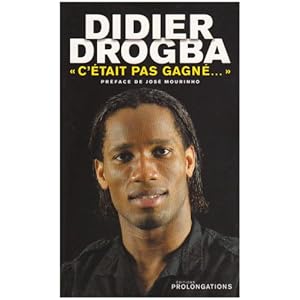
Didier Drogba : C'était pas gagné

In this autobiography Drogba reveals his journey from a painful childhood in the Parisian suburbs to the African Cup of Nations in 2008. Throughout his narrative, we discover the hidden side of both Drogba and the world he inhabits, populated by the biggest names in world football - both partners and opponents. We finally discovers the astonishing scale of this human and political player who helped to end the Ivorian civil war and is one of three players selected as a UN ambassador for development, with Ronaldo and Zidane.
Labels:
biography,
books,
Côte d'Ivoire,
Definite Book Stories,
Definite Stories,
Football,
France,
Sports
Long Distance Love: A Passion for Football

by: Grant Farred
Since he was a young adult, Grant Farred has wandered the world. Born in South Africa, his own personal growth was fuelled by dreams of English football, as a player, and then, when age and reality set in, as a fan. Coming to the United States at a still young age, Farred still loved football - especially Liverpool - and watched it from afar. Writing about his experience, Farred shares with the reader his experience growing up coloured in South Africa, moving to England, and finally to the US, and how his passion for football kept company with his many moves. Along the way, he talks about the contradictions of football; how race and class politics mix on and off the pitch; how Farred's own ideas about what it means to be a colonial subject is both reinforced and liberated by the idea of football, and how players can serve as gods and monsters. And he offers the most entertaining description of soccer and why it is the world's most popular sport. Fellow expatriates will rejoice in Grant's writing about their beloved teams, and the novice to the sport will find in "Long Distance Love" an intoxicating introduction to the Beautiful Game.
Imprint: Temple University Press,U.S.
April 2008/ 2008
ISBN-13: 978-1-59213-374-1
Subscribe to:
Posts (Atom)