1n 1998, on his 80th birthday, Nelson Mandela married former first lady of Mozambique, Graca Machel.
10 years later, we look at how Mozambicans view Graca today (2008). There are gender issues at play: from a patriarchal standpoint - where the widow of the hero is supposed to keep the memory of the nation - how do they feel? What is the feminist view? What is the history of crossborder matrimonial exchange between South Africa and Mozambique (i.e. rumours of Samora and Miriam Makeba)...What irreverent Mozambican writer or gender activist is bold enough to write such a story?
Wednesday, November 24, 2010
Michelle Mandela
Labels:
gossip,
love,
Mozambique,
politics,
South Africa
Winston Mankunku Ngozi
May 2008
Winston Mankunku Ngozi, one of South Africa's living jazz legends, is to produce his first DVD. The tenor sax and jazz composer will record live at Cape Town's Artscape Opera House at 8pm on 2 and 3 May.
It will be an orchestrated concert including the Darryl Andrews Big Band, Andile Yenana, Marcus Wyatt, Mike Perry, 12 backing vocals and many more musicians.
40 years after his famous recording of Yakhal' Inkomo in 1968, someone can write a concert review, imagined backstage interview, etc.
Winston Mankunku Ngozi, one of South Africa's living jazz legends, is to produce his first DVD. The tenor sax and jazz composer will record live at Cape Town's Artscape Opera House at 8pm on 2 and 3 May.
It will be an orchestrated concert including the Darryl Andrews Big Band, Andile Yenana, Marcus Wyatt, Mike Perry, 12 backing vocals and many more musicians.
40 years after his famous recording of Yakhal' Inkomo in 1968, someone can write a concert review, imagined backstage interview, etc.
Labels:
definite music stories,
Definite Stories,
music,
South Africa
Predicting e-readers in 1981: A look back at the future
Newspapers in the Year 2000: “Videotex services will become mature businesses…”
(This report written was originally published by APME in 1981.)
The appearance of newspapers at the beginning of the next century may be affected more by technology and economics than by the inspirations of editors and designers. That’s not to say editors and designers won’t play significant roles, they almost certainly will; however, the product itself may be radically altered by forces already being felt.
Through our imperfect eyes into the future, here are some of the developments that can be seen within the next two decades.
Read the rest here
Tuesday, November 23, 2010
Devoir de Mémoire (Rwanda)
In 2000, the publication of ten texts marked the completion of a two-year project entitled Le Devoir de mémoire [The Duty of Memory], which had brought together ten writers from across Africa to write in response to the Rwandan genocide. This article looks at how the project was posited from the outset as a specifically African response, setting this in the context of older problems of voice, self-representation and the renegotiation of miswritten histories in the postcolonial context. This aspect of the project is made all the more urgent by the actuality of the genocide, and the period of residence the writers spent in Rwanda in 1998. This article argues that the project succeeded in creating a space in which Africa as a whole is made part of the genocide, and vice versa, by raising complex questions of responsibility and by drawing on familiar themes in modern African writing, namely history, memory and identity; exile and dislocation.
Small, Audrey.
The Duty of Memory: A Solidarity of Voices after the Rwandan Genocide
Volume 30, Number 1, March 2007, pp. 85-100
Edinburgh University Press
* 2008 marks 10 years since the Rwanda residencies
* Connects to the larger movement of reconciliation literature and theatre over the last decade (in South Africa, etc.)
Small, Audrey.
The Duty of Memory: A Solidarity of Voices after the Rwandan Genocide
Volume 30, Number 1, March 2007, pp. 85-100
Edinburgh University Press
* 2008 marks 10 years since the Rwanda residencies
* Connects to the larger movement of reconciliation literature and theatre over the last decade (in South Africa, etc.)
Labels:
Definite Book Stories,
Definite Stories,
reconciliation,
Rwanda,
theatre
Like Father, Like Son
Presidential succession - a recurring theme in African politics
ten days after the January 2001 murder of Laurent Kabila, his son, Joseph Kabila, took over as president. Ali Bongo won the 2009 Gabonese presidency after the death of his father Omar Bongo. Faure Gnassingbe took over as president after the death of his father Gnassingbe Eyadema (in violation of Togo’s Constitution which stipulates that the Speaker of Parliament should succeed the president in the event of his death)*. Gamel Mubarak is being groomed to take the reigns from his father Hosni Mubarak in Egypt. In Sudan, Karim Wade is widely viewed as a strong candidate to succeed his father Abdoulaye Wade as president. Nepotism is also no stranger in Libya where Moamer Gaddafi has just named his son, Saif Al Islam Moammar Kadafi, head of state. Ugandan president Yoweri Museveni has awarded several members of his family with high ranking positions in his cabinet and is rumoured to be grooming his son, Lt Col Kainerugaba Muhoozi, to be president. Playboy Teodoro Nguema Obiang is likely next in line to take over from his father Obiang Nguema as president of the oil rich nation of Equitorial Guinea.
(Source: Lord Aikins Adusei)
How will these new dynasties affect the next era of African politics?
Laurent Kabila Jr. - DRC
Faure Gnassingbe - Togo
Gamal Mubarak; Hosni Mubarak - Egypt
Karim Wad - Senegal
Saif Al Islam Moammar Kadafi - Libya
Yoweri Museveni - Uganda
Obiang Nguema - equitorial Guinea
ten days after the January 2001 murder of Laurent Kabila, his son, Joseph Kabila, took over as president. Ali Bongo won the 2009 Gabonese presidency after the death of his father Omar Bongo. Faure Gnassingbe took over as president after the death of his father Gnassingbe Eyadema (in violation of Togo’s Constitution which stipulates that the Speaker of Parliament should succeed the president in the event of his death)*. Gamel Mubarak is being groomed to take the reigns from his father Hosni Mubarak in Egypt. In Sudan, Karim Wade is widely viewed as a strong candidate to succeed his father Abdoulaye Wade as president. Nepotism is also no stranger in Libya where Moamer Gaddafi has just named his son, Saif Al Islam Moammar Kadafi, head of state. Ugandan president Yoweri Museveni has awarded several members of his family with high ranking positions in his cabinet and is rumoured to be grooming his son, Lt Col Kainerugaba Muhoozi, to be president. Playboy Teodoro Nguema Obiang is likely next in line to take over from his father Obiang Nguema as president of the oil rich nation of Equitorial Guinea.
(Source: Lord Aikins Adusei)
How will these new dynasties affect the next era of African politics?
Laurent Kabila Jr. - DRC
Faure Gnassingbe - Togo
Gamal Mubarak; Hosni Mubarak - Egypt
Karim Wad - Senegal
Saif Al Islam Moammar Kadafi - Libya
Yoweri Museveni - Uganda
Obiang Nguema - equitorial Guinea
Labels:
Africa,
Congo,
Definite Stories,
Egypt,
Equitorial Guinea,
Libya,
politics,
Senegal,
Togo,
Uganda
Mbembe on Sarkozy's Dakar speech
Read it here
Children's Parliament - DRCongo
Children's Parliament - WITNESS - Al Jazeera English
Children's Parliament is a local organisation run by children for children. Their mission since its conception in 1999 is to fight for the rights of children. As teenage students, the parliamentarians dedicate their free time to this noble task and receive no payment, despite enormous obstacles and risk to themselves. Members of Children's Parliament are elected by their peers and delegates are chosen from different neighbourhoods, schools and districts. What unites them is their will to make a difference for Congo's children.
Nicholas Sarkozy’s Unacceptable Speech (Dakar, Feb08)
It is probably written somewhere that between Paris and its former colonies in Black Africa, nothing should follow the norms accepted by the rest of the world. Nicolas Sarkozy’s brief visit to Senegal could have gone unnoticed; instead, it served as a pretext for him to make for an unacceptable speech, one which he would not have dared give outside France’s “pré-carré” (backyard) and in front of the most insignificant of his peers. In Tunisia and Algeria, he understood that it would be improper for him to behave as if he was in a conquered territory. In North Africa he could not even gain automatic access to the popular, folkloric and degrading reception that was reserved for him in Dakar. Within the context of Dakar that reminds one of the “commandants de cercle” of colonial times, he gave a sort of State of the Union address, that is, the State of the Union française, without anyone being able to reproach him for having mistaken the historical era.
However, one must not be swayed; for even though he claimed to address the whole African continent, he was not naïve enough to believe that his country’s position would cause ripples as far as Johannesburg, Mombasa or Maputo. If intellectuals from these regions have now paid attention to the remarks of the French president, it is because they have been given a brief summary of the president’s speech beforehand. Over the last few days, they have discovered, with bewilderment, the realities of Françafrique.
Their anger is understandable. Even in francophone countries where it has been thought that things had hit the rock bottom, everyone agrees that this time the limit has been breached. Being a relatively young and inexperienced head of State does not give anyone the right to be so irresponsible. When one leads a country as important as France, he or she cannot protract the lame game of “I-am-not-like-the-others.” This arrogance, displayed by a man who could be judged as still surprised by having so easily achieved his goal, led him to entertain the most distressing clichés of 19th century ethnology in front of a particularly well-informed audience. Political science may one day take interest in this unique figure: a foreign president, from his height of 1.64 m, dares to condemn the inhabitants of an entire continent, calling upon them to distance themselves from nature in order to enter human history and invent their destiny. These statements, kept up to date by French authors anxious to comfort the prevalent Negrophobia, serve to comfort historical revisionism of colonialism, the genocide of Tutsis in Rwanda and the slave trade.
The remarks “It is Africans who sold their compatriots to the slave traders” are grossly inappropriate and particularly disingenuous coming from the president of the Republic. They are an insult to the memory of the victims and a despicable moderation of the fundamental violence of the Transatlantic trade.
Never, in the history of humanity, has a nation oppressed another without the complicity, if not zeal, of the elite of the conquered nation. According to Robert Paxton, whose work on Vichy is a classic reference text, Adolf Hitler was not particularly interested in occupying the whole of France; he was primarily keen on neutralizing the country and turning it into an aerial base. It was the French state authorities of the time who actively pressured him to be more ambitious than the devil. Who else, but French writer Charles Maurras, saluted the entry of German tankers into Paris on June 14, 1940 as a “divine surprise”? The same principle applies to other parts of the world. Without the shameful hesitation of Moctezuma – a man of weak character at the head of the powerful Aztec empire – and the petty rivalries between the numerous Indian tribes, Hernan Cortès and his handful of conquistadors would not have succeeded in submitting almost the entire continent of what is today known as Latin America under their rule.
Read the rest here (by Boubacar Boris Diop; from The Zeleza Post)
Saturday, November 20, 2010
Young Lions

"The Young Patriots represent a new kind of African success story. They’re celebrated by many young people in Abidjan for beating and cheating a system gone rancid. With the corrupt 'old fathers' refusing to get out of the way, and with all the old channels to success—emigration, foreign study, state employment, family connections—blocked, the new hero is a young trickster with a talent for self-promotion. The model is no longer the formal bureaucratic style of the French colonizer; it’s the loud, unrestrained style that everyone in Ivory Coast calls American." Wrote George Packer in the The New Yorker in 2003.
As Packer notes: "the Young Patriot leaders, local stars in their twenties who were dressed like American hip-hop singers: gold chains, tracksuits, floppy hats. Their scowling bodyguards sat behind them, wearing muscle shirts and mirror glasses; a few were armed with Kalashnikov rifles. Sitting quietly and pathetically in the back rows were the neighborhood elders. In the traditional hierarchy of African villages, the old are elaborately deferred to by the young. Here the elders had no role other than to applaud while the Young Patriots took turns swaggering and jigging out on the speaker’s platform and the loudspeakers blasted reggae or zouglou, the homegrown pop music of the movement."
Five years later Young Patriots leader Charles Blé Goudé and once rebel leader Guillaume Soro who led the Patriotic Movement of Côte d'Ivoire and later the New Forces have suited up and transformed themselves into a savvy politicians, who play leading roles in Ivoirian politics.
A few days after Soro's 36th Birthday we look at the rise of a new generation of young lions in African politics.
See the Al Jazeera special report, An Ivorian miracle? here.
Tuesday, November 16, 2010
The Spear (of the nation)

Published by Drum in Nigeria and later also Kenya and Ghana in the early 60s, African Film was just one of the many photo comics or "look books" that flooded English-speaking West Africa in the early post colonial era. Catering to the new urban youth, the series featured the mythical persona of Lance Spearman, a.k.a. "The Spear," a black James Bond-like crime fighter as the central character.
In contrast to the racist stereotype of the uncivilised, uneducated, spear-carrying cannibal, or the eroticised "noble savage" that characterised the depictions of Africans in most Western comic books from the time, Spearman was sharp, stylish and sophisticated. Combining re-appropriated Western references with a distinctly African cultural identity, he reflected a newly defined black Atlantic modernity. Here was a comic book hero that presented a potential critique of colonialism, as well as a significant variation in how the genre classically figured normality and otherness.
Since then The Spear and the comics that featured him have disappeared, but not from their fan's memory. As the comments on the Chimurenga Library website testify The Spear is one sought after individual:
"Looking up on the Chimurenga Library website, I came across so many nostalgic comments on the Boom and Film mags from those who lived in East Africa in the 60's and early 70's like myself, which brought back so many heart-wrenching memories of yester-years.... I certainly would give anything if I could get hold of that collection today... Where have the old dummy prints in the old publishing places that used to publish these mags gone? If those were found or maybe the kids or grand kids of the editor/s(who would be grown-ups now) could be traced, there may be a chance that these wonderfully entertaining photo comics-BOOM and FILM could be resurected. My God, how blessed myself and all of us would be to be able to re-live our childhoods-those glorious years again!"
More here.
We investigate the legacy and the grip of the infamous Spear on the imagination of a generation. It's also a treasure hunt: where is the Spear today and who has the lost stash of African Film magazines?
The Ghetto Biennale
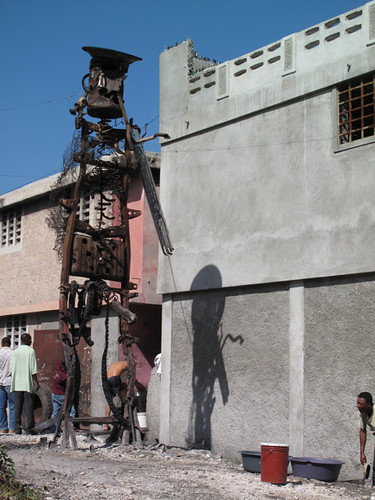
A bustling boulevard in downtown Port-au-Prince seems an unlikely place for an art installation. But, towering over a vacant lot is a 20-foot-tall statue of Legba, the voodoo spirit guardian of the gateway. It’s made out of a car chassis and chunks of a defunct truck. Its creator is André Eugene, one of the sculptors of the Grand Rue.
The Grand Rue is the main avenue that runs north–south through downtown Port-au-Prince. At the avenue’s southern end is a close-knit collective of artists whose sculptural collages of engine manifolds, computer entrails, TV sets, medical debris, skulls and discarded lumber transforms the detritus of a failing economy into deranged, post-apocalyptic totems.
Refused visas, the Grand Rue sculptors were excluded from a private view of their work in a major museum in Miami. A lack of government support makes them economically excluded from all major biennales. In response they organised the Ghetto Biennale.
Rather than bringing completed artworks, as with a traditional biennial, the artists chosen for the Ghetto Biennale created their works in the Grand Rue.
By virtue of its self-organised autonomy, the specificity of the site, and its participatory and relational structure, the first Ghetto Biennale genuinely seemed to disrupt the zones of exclusion entrenched in both contemporary art systems and the geopolitics of the global poor. In this amorphous, chaotic,de-institutionalised space, the distinctions between artist and audience, and between city and gallery appeared momentarily blurred. In the conference which followed, consensus was that a liberated, revolutionary space had emerged.
Monday, November 15, 2010
The raw and the cooked

Kai, a fantastic writer known to some of us here, has a version of this piece in 14; he's been planning to expand it for years. Needs a high-level nudge to do so, perhaps even the promise of a fistful of mp3s of 1970s funk in return for his labour.
If Ntone can make him do it, there's a fantastic piece to be had on the next great economic power's last big secret.
Faustin and Studio Kabako
A review of the work from Festival of Lies to workshopping More...future with Flamme and Xuly (well documented via vids and such) - the Kabako project in Kin and Kisangani. Interview, Studio visit, something.
Studio Kabako Website
amaNdiya
amaNdiya article
Feels like a century ago - but maybe we revisit as entry point, the role of music vs pc-ness etc? In many ways, set the tone for "ordinary people" songs to re-come from Zuma's ANC - where now it's about who sings loudest - when you google this you get Zapiro's cartoons of Zuma...
Kwanele?
Feels like a century ago - but maybe we revisit as entry point, the role of music vs pc-ness etc? In many ways, set the tone for "ordinary people" songs to re-come from Zuma's ANC - where now it's about who sings loudest - when you google this you get Zapiro's cartoons of Zuma...
Kwanele?
Saturday, November 13, 2010
Race (or not) & "I don't want to sleep alone"
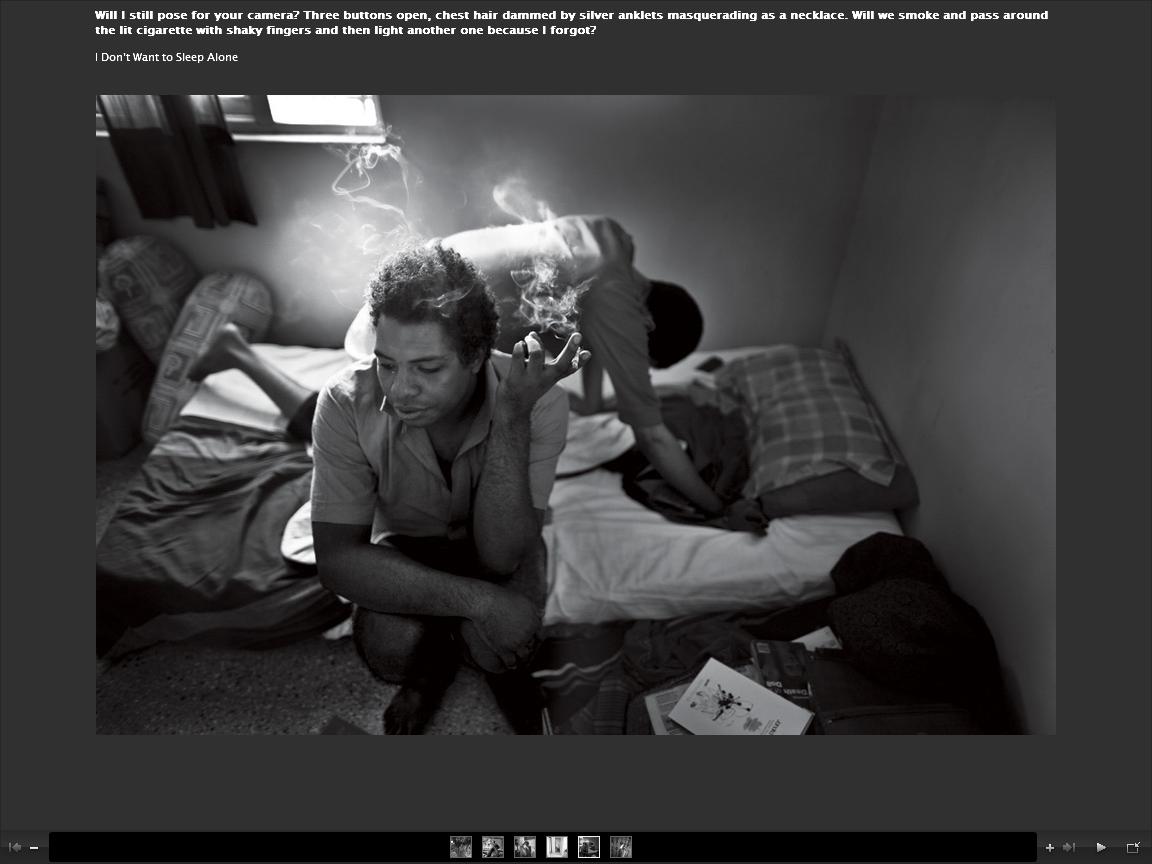
Two (possible) sideways perspectives: Joshua, a young poet and journalist from Bangalore, has a poetry/photo collaboration called "I don't want to sleep alone" which is nice and gritty, preview here. He also wrote a (tame) piece on looking black and not really knowing it - "Sometimes you have to use racism to your advantage" - available here, and could expand that into a family story, or at least the kind of story unfit to print in a family magazine like the one it originally ran in.
Subscribe to:
Comments (Atom)