Showing posts with label Race. Show all posts

Monday, November 29, 2010

Arab and African or both...or something...in Sudan

Alex de Waal is an excellent writer, and also someone whose position on things Sudanese is interesting and complex. (I'm curious to know if there's other good stuff out there: I know only of Mahmood Mamdani, whose work on Darfur and Sudan has been more polemical, or at least polemically anti-polemical.)

I am interested in how one belongs in Sudan because virtually all popular commentary on Sudan is about 'Arabs' and 'Africans.'

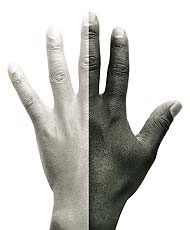
How do faces and races reconcile? Arab, African, Ararican, Afrab? Or nothing?

I remember coming across this peculiarly endearing outcome of anthropology in a shop that sold old maps. Facial anthropology.


Invariably, this kind of exercise reveals far greater truths than it might have intended to.


How about a pictorial guide to face and race in Sudan? As they change with time?

Monday, November 15, 2010

The raw and the cooked


Kai, a fantastic writer known to some of us here, has a version of this piece in 14; he's been planning to expand it for years. Needs a high-level nudge to do so, perhaps even the promise of a fistful of mp3s of 1970s funk in return for his labour.

If Ntone can make him do it, there's a fantastic piece to be had on the next great economic power's last big secret.

Tuesday, October 12, 2010

Writer: Ashwin Desai

Author of The Race to Transform: Sport in Post-Apartheid South Africa

"Post-apartheid South Africa put great stock in the potential of sport to break down racial barriers and build a united nation. The 1995 Rugby World Cup victory, and Nelson Mandela’s now-famous appearance in a Springbok jersey, seemed perfect catalysts for the dream of a “rainbow nation”.

In The Race to Transform, editor Ashwin Desai and eight other authors examine elements of change in a number of sports arenas including swimming, athletics, rugby, soccer and cricket.

With kick-off to the FIFA 2010 Football World Cup mere weeks away, this timely book takes stock of sport in South Africa, and provides a pioneering exploration of how sport reflects matters such as enduring inequality, racial transformation and the making (or otherwise) of a common South African destiny. Divided into chapters delving into a diverse set of sporting codes, the book enlivens and transcends the technical debates and contestations around transformation that have become such a prominent part of sports discourse. The book places an emphasis on how South Africa’s transition has impacted on township sport. Moreover, it provides a view on the relationship between elite and grassroots sport in the context of growing economic disparities.

Tuesday, September 14, 2010

European Xenophobia: 68% of Italians want Roma expelled


• Government accused of stoking racial tension

• Yobs boast of ethnic cleansing after attacks

Sixty-eight per cent of Italians, fuelled by often inflammatory attacks by the new
rightwing government, want to see all of the country's 150,000 Gypsies, many of them
Italian citizens, expelled, according to an opinion poll.

“Negros x Brancos” (Blacks against whites) in Brazil


manipulating color and race in Brazil

Luiz Schwarcz, who was beginning to build the company he had founded, Companhia das Letras, into one of the finest publishing houses in Latin America.

“In Brazil, you are what you describe yourself to be. Officially we have five different colors—black, white, yellow, indigenous, and pardo (meaning “brown,” “brownish,” or “gray-brown”), but in reality, as research has demonstrated, we have more than 130 colors. Brazilians like to describe their spectrum of colors as a rainbow and we also think that color is a flexible way of categorizing people. For several years, I have been studying a soccer game called “Pretos X Brancos” (Blacks against whites), which takes place in a favela of São Paulo, called Heliópolis. In theory, it pits eleven white players against eleven black players. But, every year they change colors like they change socks or shirts—one year a player will choose to play for one team,the next year for the other, with the explanation that, “I feel more black,” or “I feel more white.” Also, in Brazil, if a person gets rich, he gets whiter. I recently talked with a dentist in Minas Gerais. As he is becoming old, his hair has turned white, and he is very well recognized in his little town. He started smoking cigars, joined the local Rotary Club, and said to me: “When I was black my life was really difficult.” So one can see how being white even nowadays is a powerful symbol. Here we have two sides of the same picture: on the one hand, identity is flexible; on the other hand, whiteness is ultimately what some people aspire to. But one aspect is common, the idea that you can manipulate your color and race.