Showing posts with label Art. Show all posts

Wednesday, November 24, 2010

Abdoulaye Wade's Monument to the North Korean Renaissance


As North Korea goes to war or straight to hell, some might forget that in April this year, a fantastic monument was perpetrated upon an unwitting public in Dakar. And lil' ol' Kim had a hand in it.


Salient facts:

Cost: $27 million

Provenance: Concept and design by President Abdoulaye Wade

Execution: North Korea

Ownership: Wade would like 35% of all ticket sales since it's his Intellectual Property after all

I have no idea how one would do anything with this retrospectively, but it seemed too good and too topical not to bring up in these trying times for family businesses.

Here's Wikipedia on the African Renaissance Monument; and this is the BBC (Jesse Jackson was there).

Tuesday, November 16, 2010

The Ghetto Biennale


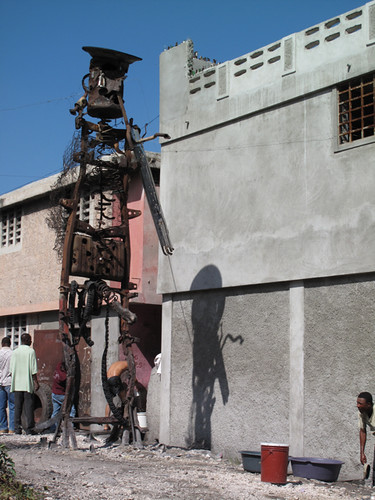
 A bustling boulevard in downtown Port-au-Prince seems an unlikely place for an art installation. But, towering over a vacant lot is a 20-foot-tall statue of Legba, the voodoo spirit guardian of the gateway. It’s made out of a car chassis and chunks of a defunct truck. Its creator is André Eugene, one of the sculptors of the Grand Rue.

The Grand Rue is the main avenue that runs north–south through downtown Port-au-Prince. At the avenue’s southern end is a close-knit collective of artists whose sculptural collages of engine manifolds, computer entrails, TV sets, medical debris, skulls and discarded lumber transforms the detritus of a failing economy into deranged, post-apocalyptic totems.

Refused visas, the Grand Rue sculptors were excluded from a private view of their work in a major museum in Miami. A lack of government support makes them economically excluded from all major biennales. In response they organised the Ghetto Biennale.

Rather than bringing completed artworks, as with a traditional biennial, the artists chosen for the Ghetto Biennale created their works in the Grand Rue.

By virtue of its self-organised autonomy, the specificity of the site, and its participatory and relational structure, the first Ghetto Biennale genuinely seemed to disrupt the zones of exclusion entrenched in both contemporary art systems and the geopolitics of the global poor. In this amorphous, chaotic,de-institutionalised space, the distinctions between artist and audience, and between city and gallery appeared momentarily blurred. In the conference which followed, consensus was that a liberated, revolutionary space had emerged.


Wednesday, November 10, 2010

Okwui Enwezor's Archive Fever

Archive Fever: Uses of the Document in Contemporary Art
International Center of Photography
New York, New York
January 18 - May 4, 2008

Enwezor: "…I want to make a distinction between curating within the canon and curating within culture."

Archive fever : uses of the document in contemporary art /
Okwui Enwezor [curator].
Gottingen : Steidl ; London : Thames & Hudson
May, 2008.
ISBN: 9783865216229 (pbk.)

Organized and written by renowned scholar and ICP Adjunct Curator Okwui Enwezor, Archive Fever presents works by leading contemporary artists who use archival documents to rethink the meaning of identity, history, memory, and loss. Over the past thirty years, successive generations have taken wide-ranging approaches to the photographic and filmic archive. The works presented here take many forms, including physical archives arranged by peculiar
cataloguing methods, imagined biographies of fictitious persons, collections of found and anonymous photographs, film versions of photographic albums, and photomontages composed of historical photographs. These images have a wide-ranging subject matter yet are linked by the artists shared meditation on photography and film as the quintessential media of the archive. Artists in the exhibition include Tacita Dean, Stan Douglas, Felix Gonzalez-Torres, Zoe Leonard, Ilán Lieberman, Walid Raad, Thomas Ruff, Anri Sala, Fazal Sheikh, Eyal Sivan, Lorna Simpson, and Vivan Sundaram, among others.

Wednesday, October 13, 2010

Africa in China

Most of the debates on China in Africa has followed the flow from China to Africa but its not all one way traffic. Areas like "Chocolate City" in Guangzhou, China attracts thousands of African traders seeking business opportunities in the East. What the view like from this perspective?

Artists Bill Kouélany & Goddy Leye recently visited "Chocolate City" as part of their Sparck residency and produced "Chocolate Banana"

Also see Farhad A.K. Sulliman KHOYRATTY (fiction writer, editor, translator; Mauritius) Journey to the West published at 2010 IWP:

"I was in Hubei province, having boarded the ship a week earlier at Shanghai, a good
few provinces east. I was heading upstream towards East Tibet. It wasn’t a ship really, more
a low‐cost transport craft, a riverboat.
This is how I describe myself: 43, elegant, an adventurer at heart. My name’s Marco,
one of the most common names among Mauritian Christians my age. I am of Black African
origin spiked with some French here and there. I was brought up a Catholic but am now as
lapsed as can be. My wife, Lakshmi, is Mauritian Hindu...." More here

Thursday, September 16, 2010

Theatre of Reconciliation


‘The dominant theme in South African theatre over the last ten years seems to be the legacy of the TRC, which uncovered more in the way of truth than it accomplished in reconciliation. Yael Farber’s MoLoRa, Lara Foot Newton’s Reach, Sindiwe Magona’s Mother to Mother, REwind: A Cantata by composer Philip Miller, and Truth in Translation by director Michael Lessac, all explored forgiveness.’

2008 also marks the ten year anniversary of the publication of the play Ubu and the Truth Commission.

[has their been a similar trend in the Rwandan theatre, or other areas faced with reconciliation?]


source

Wednesday, September 15, 2010

Animation in Kenya


"Kenyanimation blog was set up to bring together animators and animation fans who are from or work in Kenya, just to show people that there actually is such a thing as Kenyan animation, and hopefully be a launching point for bigger local projects, which haven’t had a chance so far coz people don’t really know that a scene exists!"

Dak'art 2008: an opportunity to revisit Laboratoire Agit-Art?


"The Dakar-based Laboratoire Agit-Art was founded in 1973-74 by an interdisciplinary group of artists, writers, filmmakers, performance artists, and musicians. Laboratoire's aim was to transform the nature of artistic practice from a formalist, object-bound sensibility to practices based on experimentation and agitation, process rather than product, ephemerality rather than permanence, political and social ideas rather than aesthetic. Audience participation was of paramount importance to the group's work, which privileged communicative acts over the embodied object. Neither utopian nor self-referential, Laboratoire grounded its actions in the immediate sociopolitical situation. Whether or not the group was aware of similar practices in the West, Laboratoire's position on art after the object is supremely consistent with Lucy Lippard's assertion that conceptual art was "emerging from two directions: art as idea and art as action."

Compare with contemporary situation?

Tuesday, September 14, 2010

The Metro we missed


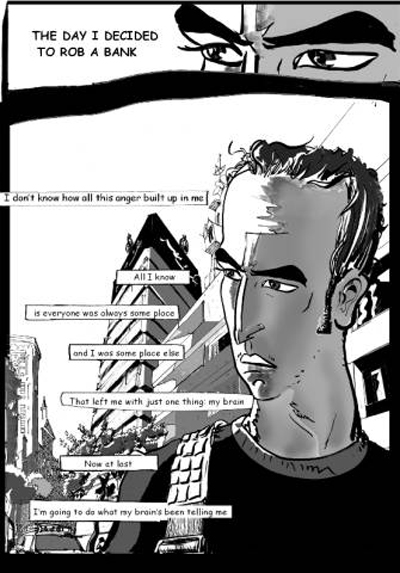
The first Egyptian graphic novel, The Metro, was confiscated by the authorities last week a few months after its publication, writes Rania Khallaf Magdy El-Shafie, author and cartoonist of The Metro, widely regarded as the first Egyptian graphic novel, last week received a summons to appear before the state prosecution service following the confiscation of his novel from the publisher, Malameh. Mohammed El-Sharqawy, head of Malameh, also received a summons, this time following 15 days spent in prison as a result of his participation in the 6 April strikes.

According to the state prosecution service, El-Shafie's graphic novel, his first, contains obscenity and libelous references alleging corruption on the part of prominent Egyptian political figures. The confiscation of the novel has caused some in Egypt's cultural community to recall previous such incidents, including when the novel A Banquet for Seaweed by Syrian novelist Haydar Haydar was confiscated on similar charges in 2000.

Formal Demand For The Return Of Benin Bronzes: Will Western Museums Now Return Some Of The Looted/Stolen Benin Artefacts?


We have often heard from those holding on to the looted/stolen Benin artefacts that there has not been any demand for their return by the owners. This is, of course, a blatant lie which often reminds one of an absurd theatre piece. A performer states clearly a view point and immediately thereafter, another character tells the audience that so far no such statement has been made. We have the remarkable situation in which the King of Benin, the Oba, writes in an introductory note in the catalogue of the exhibition Benin: Kings and Rituals -Court Arts from Nigeria requesting the return of some of the Benin cultural artefacts. Almost immediately thereafter, we have directors of four museums organizing the exhibition with the co-operation of Nigeria declaring in a preface that they have no intention of returning these objects and advising the Nigerians to forget the past and look to the future. (2) The Benin demand was also stated by the Enogie of Obazuwa, brother of the Oba, at the opening of the exhibition on 9 May 2008. Some months after the exhibition in Vienna, the show which went to Paris (October 2, 2007-January 6, 2008) moved to Berlin (February 7-May 25, 2008) and we had people from the Berlin Ethnology Museum creating the impression that there had been no request for the return of the Benin bronzes even though at the opening of the exhibition, the Nigerian Minister of Tourism, Culture and National Orientation, Prince Adetokumbo Kayode, had clearly stated the wish of the Nigerians to have back their cultural objects. (3) What kind of game is this?

http://www.modernghana.com/newsthread2/194823/39/

Dak'Art 2008


9 May - 9 June 2008
Dakar, Senegal

Sénégal (10), Cameroon (5), South Africa (5) and Egypt (3) are the most represenetd countries in the 2008 selection.

- Benin (1):
Pélagie GBAGUIDI

- Burkina Faso (2):
Saïdou DICKO
Justin Kabré (Kely)

- Cameroon (5):
Blaise BANG
Angele Etoundi ESSAMBA
Achille KOMGUEM (Achillekà)
Samuel NJA KWA
Guy Bertrand Woueté Lotchouang

- Côte d’Ivoire (1):
Jems Robert KOKOBI

- Egypt (3):
Amal EL KENAWY
Georges Fikry-Ibrahim
Fathi HASSAN

- Mali (1):
Mohamed Konaté

- Morocco (1):
Zakaria RAMHANI

- Nigeria (1):
Osaretin IGHILE

- RD Congo (1):
Freddy TSIMBA

- Senegal (10):
El Hadji Mansour CISS
Soly Cissé
Samba FALL
Abdoulaye Armin KANE
Amadou Kane SY dit Kan-Si"
Ndary LO
Ousmane NDIAYE (Dago)
Babacar NIANG
Ibrahima NIANG (Piniang)
Seydi SAMBA (Pape Seydi)

- South Africa (5):
Nandipha Mntambo
Nkosikhona Ngcobo-Bongamahlubi
Sonya Rademeyer
Athi-Patra Ruga
Johann Van Der Schijff

- Togo (1):
Sokey

- Tunisia (1):
Mourad GHARRACH

- Diaspora (3):
Grace NDIRITU (UK)
Gabriel PACHECO (USA)
Roberto Rico (Guadeloupe France)

Curator's Eye 3: The newness and nowness of our cultural past


The Curator's Eye III opened at the National Gallery of Jamaica on April 27, 2008. The show comes around every two years and provides a thesis about contemporary Jamaican art propsed by an internationally invited curator. The curators invited in the past have been Lower Stokes Sims and Eddie Chambers. This year Keith Morrison of the Tyler School of Art was invited. From September 2007, artists were invited to share in Morrison's vision for this show- Ceremony in Space, Time and Sound.

The National Gallery's press release lists the artists exhibiting as:

LOCAL ARTISTS:
Cleve Bowen, Carol Campbell, Carol Crichton, Paula Daley, Andy Jefferson, Ras Kassa, O'Neil Lawrence, Khepera Oluyia Hatshepwa and Oneika Russell.

INTERNATIONAL ARTISTS:Albert Chong, Michelle Eistrup, Lawrence Graham-Brown, Ebony G. Patterson and Tal Rickards'

Monday, September 13, 2010

The Life and Times of Richard Onyango


A street-to-canvas account of one of Kenya's most successful artists, from his beginnings as a musical apprentice at the Coast, to lover of Drossie, to his emergence as a force in the international art world.

68pp, KENYA. KWANI TRUST.
2008 9789966700858 Paperback

Friday, September 10, 2010

Art and Revolution - The Life and Death of Thami Mnyele


Diana Wylie
April 2008

Thami Mnyele's life spanned the era of apartheid. He was born the same year the National Party won office and came of age in a time (the 1960s) and a place (Johannesburg) that ofjavascript:void(0)fered a sensitive young black artist little encouragement. In 1985, in the waning days of apartheid, he was killed by South African Special Forces operatives in Gaborone, Botswana, where he had joined the banned African National Congress. Although reticent by nature, he played a vanguard role in efforts to throw open the doors of South African culture.

Thami Mnyele's story sheds light on this tumultuous era from an unusual perspective: that of an artist and not a “young lion.” Not only does Mnyele's story help us understand the birth of a modern African aesthetic; it also addresses the genesis of revolutionary commitment. How did a man come to face the prospect of martyrdom and learn to accept it? How did this choice affect what he was able to express as an artist?


Diana Wylie's beautifully written and illustrated literary biography reveals the struggles inside and around a gentle South African artist as he remade himself into a revolutionary soldier, and brings fresh insights to our understanding of South Africa's recent history.

Diana Wylie is Professor of History at Boston University. She is the author of A Little God: The Twilight of Patriarchy in a Southern African Chiefdom and Starving on a Full Stomach: The Triumph of Cultural Racism in Modern South Africa (Virginia), which won the Melville J. Herskovits Award.


Published by Jacana Media
Imprint: Jacana Media
Country of origin: South Africa
April 2008
Authors: Diana Wylie
ISBN-13: 978-1-77009-346-1
Categories: Biography & autobiography
LSN: 1-77009-346-X

Tuesday, June 22, 2010


All City Writers The book, a massive volume of more than 400 pages, has been conceived as an imaginary newspaper. The chronicles it contains have not been penned by real journalists or narrators, but by people who define themselves as ‘writers’. 406 Pages, Format: 24,5 cm x 33,5 cm Hardcover.

read more...

Wednesday, May 12, 2010

Newspaper Blackout

"Instead of starting with a blank page, poet Austin Kleon grabs a newspaper and a permanent marker and eliminates the words he doesn't need."
(NPR)


"Underlining. Highlighting. Circling. When we read interactively, when we 'alter' texts, we’re isolating little bits of writing that speak to us. Fire our imaginations. Illuminate something.

It’s the same thing when we hyperlink: we’re pointing to something that speaks to us.

When the CIA redacts a document:


It’s the same practice done in the opposite spirit: they’re isolating text that speaks to no one." ~ Austin Kleon

source