Showing posts with label Writers. Show all posts

Friday, November 12, 2010

Dany Laferrière Interview


Still life bathed in warm light: a porcelain bathtub with claw feet, sumptuous white towels draped over the edge, a table set with a stack of books and a glass of red wine. A Monday night in May, and 400 people fill the darkness of Montreal’s Place des Arts’ Cinquième Salle, waiting for Dany Laferrière. He seems to glide onstage, slim, tall, impeccably dressed in a dark suit and a white shirt open at the neck — a gentleman writer or, as the French are saying, un grand écrivain.

Instant applause. They know him well, maybe too well. How as a penniless refugee from Haiti, he chucked his menial job to write a novel about a penniless Haitian refugee writing a novel about himself. A mythical summer in a sweltering apartment on rue St-Denis, drinking, womanizing, reading, writing about the meaning of it all, sure it would lift him out of poverty and obscurity. He took the manuscript first to Jacques Lanctôt, the former FLQ activist turned publisher, warning him to expect a bomb. And he was right.

To the monoculture of Quebec, caught up in the sovereignty debate, Comment faire l’amour avec un Nègre sans se fatiguer offered an exhilarating mix of provocation and humour. Politics, too, but nothing to do with local obsessions. “In the scope of Western values,” the narrator announced, “white woman is inferior to white man, but superior to black man. That’s why she can’t get off except with a Negro. It’s obvious why: she can go as far as she wants with him. The only true sexual relation is between unequals.”

Published in 1985, it was an instant bestseller in Quebec. The translation by David Homel, How to Make Love to a Negro, came out a year later, drawing delirious reviews across Canada as well as in the UK and the US. And, as in the novel, life obeyed art. The author was invited on Denise Bombardier’s popular Radio-Canada TV show, leading to an avalanche of publicity, which he parlayed into a media career spanning the gamut from TV weatherman (a job he famously once performed naked) to talk show regular, literary columnist, and filmmaker. His second book, éroshima, found the author reading the Japanese poet Basho and enjoying sex with Japanese girls. A new book followed every year or so, always first person, in the same pithy style and often very funny — a chronicle of the life and times of a narrator everybody figured must be Dany Laferrière.

Excerpt from 'The Work of Art' by Marianne Ackerman. First appeared in Sept. 2010 issue of The Walrus.

Thursday, November 11, 2010

Danticat on Aristide


Possible writer for Aristide interview

[Danticat] returns to Haiti every three or four months, most recently in January [2004] -- just before the beginning of this year's violence, which ultimately led to the ouster of President Jean-Bertrand Aristide.

"Things hadn't unraveled yet when I was there," Danticat says. "The demonstrations had started ... but you didn't know what kind of storm was coming. There were pro-Aristide demonstrations and anti-Aristide demonstrations. It was sort of going back and forth, and I couldn't tell how it was going to end."

Because her new novel and its attendant publicity tour coincided with Aristide's unseating, Danticat often finds herself, as a respected Haitian-American novelist whose subject is her native county, asked to explain and interpret what's going on. But, she says, the role of commentator ill suits her.

"I don't have any idea, and I'm not afraid to say that," she says. "I don't have the big picture -- first of all because I live here, and second because I'm a fiction writer. My best reaction is my fiction, and that takes some time and reflection and nuance."

Further, she says, she's incapable of the sound-bite assessment that is useful for journalists. "The situation is so complicated anyway, and I don't have the luxury of declaring somebody totally evil or somebody totally saintly. ... So I say I do not know."

source


"She recalls the 1991 coup against Aristide as shocking, "but people rallied". After college, she lobbied for his return while working as an intern for Demme... Danticat met Aristide in New York ("he was very charismatic") and again at the presidential palace in 1994, when she first went back to Haiti to work with Demme on a documentary about the priest's return. "He seemed to embody the pains of the poorest people of Haiti; people loyal to him were so loyal," she says. She was later associate producer on Benoît's film Courage and Pain (1996), testimony from Aristide supporters who survived torture."

Aristide's exile has left her with "very complicated feelings. I wish there could have been a mediated solution, in which those who voted for him didn't think their vote meant nothing. Now there's a wave of violence because they feel they have nothing to lose." As for the desired outcome, "it's not up to me, and certainly not up to the US and France to decide".

source

Sunday, October 17, 2010

Fuck Granta… thanks, Granta


"If I was smart, I would have waited a few years and made an iPhone app: a little satirical story about how to write about Africa every day, interactive and adaptable, for ninety-nine cents. Fuck Granta… thanks, Granta." Binyavanga Wainaina

In 1962, as many African countries were gaining independence, Heinemann’s African Writer’s Series introduced some of Africa’s most important writers to the continent, and to the world. At the time, the idea of a series spanning the continent seemed reasonable: many countries were encountering the same phenomenon, at the same time.

Almost 50 years later, the media revolution combined with the ongoing flow of immigration has opened up a chapter in African writing. A new generation of African writers has arrived Over the past six years, partly through the efforts of publishing and literary networking through institutions like Kwani (www.kwani.org), Farafina (www.kachifo.com) and Chimurenga (www.chimurenga.co.za). In 2005 Granta published The View from Africa, featuring "fresh voices from Africa, in all their differences". In the same year Bard College created the Chinua Achebe Center for African Writers and Artists, "a world class institution that serves a new generation of African writers". The Orange Prize for Fiction was awarded in London 2007 to Chimamanda Ngozie Adichie's Half of a Yellow Sun, and the Caine Prize for African Writing has introduced new writers to agents and publishers. Writers like Chimamanda Adichie, Alain Mabanckou, Chris Abani, Petina Gapah, Marie Ndiaye and Seffi Ata are known and read in many African countries, in the African diaspora, and in Europe and America.

Tuesday, October 12, 2010

Writer: Ashwin Desai

Author of The Race to Transform: Sport in Post-Apartheid South Africa

"Post-apartheid South Africa put great stock in the potential of sport to break down racial barriers and build a united nation. The 1995 Rugby World Cup victory, and Nelson Mandela’s now-famous appearance in a Springbok jersey, seemed perfect catalysts for the dream of a “rainbow nation”.

In The Race to Transform, editor Ashwin Desai and eight other authors examine elements of change in a number of sports arenas including swimming, athletics, rugby, soccer and cricket.

With kick-off to the FIFA 2010 Football World Cup mere weeks away, this timely book takes stock of sport in South Africa, and provides a pioneering exploration of how sport reflects matters such as enduring inequality, racial transformation and the making (or otherwise) of a common South African destiny. Divided into chapters delving into a diverse set of sporting codes, the book enlivens and transcends the technical debates and contestations around transformation that have become such a prominent part of sports discourse. The book places an emphasis on how South Africa’s transition has impacted on township sport. Moreover, it provides a view on the relationship between elite and grassroots sport in the context of growing economic disparities.

Writer: Andrew Jennings

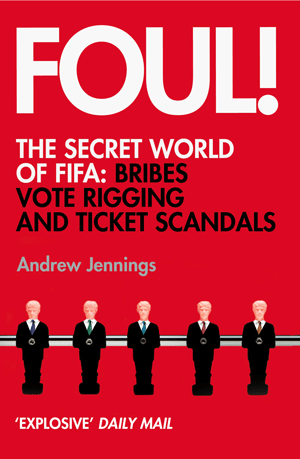
Author of Foul! The Secret World of FIFA: Bribes, Vote rigging and Ticket Scandals


"FOUL! is the result of seven year's research into the dark depths of the men controlling the world's favourite game. It charts the degeneration of FIFA under the leadership of Joao Havelange and Sepp Blatter.

It reveals the vote-rigging that put Blatter in power and the cronyism and ticket rackets that keep him there. And in the background ... the relentless flow of kickbacks to selected officials in return for billion-dollar contracts.

In a sensational interview for the new and updated paperback edition an executive involved in paying the bribes reveals how the money was laundered, at regular intervals, through off-shore bank accounts.

Another chapter digs deeper into FIFA vice-president Jack Warner’s vast World Cup ticket racket. And there’s new disclosures about the disastrous decision by FIFA to lie to MasterCard and VISA, forge a signature on a backdated contract and crudely edit a tape of a FIFA committee meeting, hoping to fool a New York judge."

Paperback: 448 pages
Publisher: Harper Collins Publ. UK (April 30, 2007)
ISBN-10: 0007208693
ISBN-13: 978-0007208692

Tuesday, September 14, 2010

Per Ankh Publishers


Ayesha Harruna Attah was born in Accra, Ghana. With a fellowship from Per Ankh Publishers (2007 - April 2008) and TrustAfrica, she wrote her first novel, Harmattan Rain, which was shortlisted for the 2010 Commonwealth Writers' Prize, Africa Region. She was educated at Mount Holyoke College and Columbia University and is currently pursuing her creative writing MFA at NYU.

Mildred Kiconco Barya (1976- ), born Owemigisha Patricia on 1 August 1976, is a writer and poet from Uganda. She was awarded the 2008 Pan African Literary Forum Prize for Africana Fiction, but remains best known for her poetry, particularly her first two collections, Men Love Chocolates But They Don't Say (2002), and The Price of Memory: After the Tsunami (2006).

Barya has also worked as journalist and travel writer, and currently (as of August 2007 until August 2009) serves as Writer-In-Residence at TrustAfrica, a Pan-African foundation based in Dakar, Senegal. Barya also currently resides in Senegal, although she has previously lived and worked in Germany, Botswana, Kenya and Uganda. Besides her career as a writer, Barya has also worked as a Human Resource Advisor for Ernst & Young in Uganda.

[One of the Per Sesh Writing Program residents?]

Reflection / history of Per Ankh

Significance of choosing to publish in Africa (Bibi on relationship African / international publishers)