Showing posts with label Haiti. Show all posts
Tuesday, November 16, 2010
The Ghetto Biennale
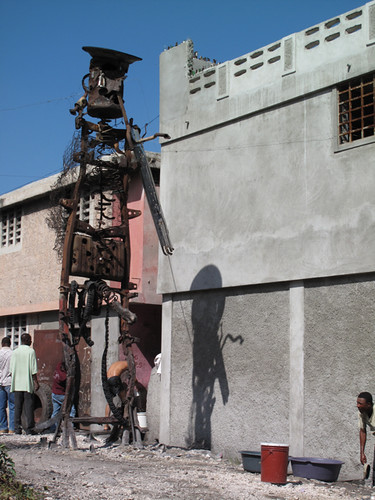
A bustling boulevard in downtown Port-au-Prince seems an unlikely place for an art installation. But, towering over a vacant lot is a 20-foot-tall statue of Legba, the voodoo spirit guardian of the gateway. It’s made out of a car chassis and chunks of a defunct truck. Its creator is André Eugene, one of the sculptors of the Grand Rue.
The Grand Rue is the main avenue that runs north–south through downtown Port-au-Prince. At the avenue’s southern end is a close-knit collective of artists whose sculptural collages of engine manifolds, computer entrails, TV sets, medical debris, skulls and discarded lumber transforms the detritus of a failing economy into deranged, post-apocalyptic totems.
Refused visas, the Grand Rue sculptors were excluded from a private view of their work in a major museum in Miami. A lack of government support makes them economically excluded from all major biennales. In response they organised the Ghetto Biennale.
Rather than bringing completed artworks, as with a traditional biennial, the artists chosen for the Ghetto Biennale created their works in the Grand Rue.
By virtue of its self-organised autonomy, the specificity of the site, and its participatory and relational structure, the first Ghetto Biennale genuinely seemed to disrupt the zones of exclusion entrenched in both contemporary art systems and the geopolitics of the global poor. In this amorphous, chaotic,de-institutionalised space, the distinctions between artist and audience, and between city and gallery appeared momentarily blurred. In the conference which followed, consensus was that a liberated, revolutionary space had emerged.
Friday, November 12, 2010
Dany Laferrière Interview
Still life bathed in warm light: a porcelain bathtub with claw feet, sumptuous white towels draped over the edge, a table set with a stack of books and a glass of red wine. A Monday night in May, and 400 people fill the darkness of Montreal’s Place des Arts’ Cinquième Salle, waiting for Dany Laferrière. He seems to glide onstage, slim, tall, impeccably dressed in a dark suit and a white shirt open at the neck — a gentleman writer or, as the French are saying, un grand écrivain.
Instant applause. They know him well, maybe too well. How as a penniless refugee from Haiti, he chucked his menial job to write a novel about a penniless Haitian refugee writing a novel about himself. A mythical summer in a sweltering apartment on rue St-Denis, drinking, womanizing, reading, writing about the meaning of it all, sure it would lift him out of poverty and obscurity. He took the manuscript first to Jacques Lanctôt, the former FLQ activist turned publisher, warning him to expect a bomb. And he was right.
To the monoculture of Quebec, caught up in the sovereignty debate, Comment faire l’amour avec un Nègre sans se fatiguer offered an exhilarating mix of provocation and humour. Politics, too, but nothing to do with local obsessions. “In the scope of Western values,” the narrator announced, “white woman is inferior to white man, but superior to black man. That’s why she can’t get off except with a Negro. It’s obvious why: she can go as far as she wants with him. The only true sexual relation is between unequals.”
Published in 1985, it was an instant bestseller in Quebec. The translation by David Homel, How to Make Love to a Negro, came out a year later, drawing delirious reviews across Canada as well as in the UK and the US. And, as in the novel, life obeyed art. The author was invited on Denise Bombardier’s popular Radio-Canada TV show, leading to an avalanche of publicity, which he parlayed into a media career spanning the gamut from TV weatherman (a job he famously once performed naked) to talk show regular, literary columnist, and filmmaker. His second book, éroshima, found the author reading the Japanese poet Basho and enjoying sex with Japanese girls. A new book followed every year or so, always first person, in the same pithy style and often very funny — a chronicle of the life and times of a narrator everybody figured must be Dany Laferrière.
Excerpt from 'The Work of Art' by Marianne Ackerman. First appeared in Sept. 2010 issue of The Walrus.
Labels:
books,
Canada,
Definite Book Stories,
Definite Stories,
fiction,
Haiti,
Writers
Thursday, November 11, 2010
Danticat on Aristide
Possible writer for Aristide interview
[Danticat] returns to Haiti every three or four months, most recently in January [2004] -- just before the beginning of this year's violence, which ultimately led to the ouster of President Jean-Bertrand Aristide.
"Things hadn't unraveled yet when I was there," Danticat says. "The demonstrations had started ... but you didn't know what kind of storm was coming. There were pro-Aristide demonstrations and anti-Aristide demonstrations. It was sort of going back and forth, and I couldn't tell how it was going to end."
Because her new novel and its attendant publicity tour coincided with Aristide's unseating, Danticat often finds herself, as a respected Haitian-American novelist whose subject is her native county, asked to explain and interpret what's going on. But, she says, the role of commentator ill suits her.
"I don't have any idea, and I'm not afraid to say that," she says. "I don't have the big picture -- first of all because I live here, and second because I'm a fiction writer. My best reaction is my fiction, and that takes some time and reflection and nuance."
Further, she says, she's incapable of the sound-bite assessment that is useful for journalists. "The situation is so complicated anyway, and I don't have the luxury of declaring somebody totally evil or somebody totally saintly. ... So I say I do not know."
source
"She recalls the 1991 coup against Aristide as shocking, "but people rallied". After college, she lobbied for his return while working as an intern for Demme... Danticat met Aristide in New York ("he was very charismatic") and again at the presidential palace in 1994, when she first went back to Haiti to work with Demme on a documentary about the priest's return. "He seemed to embody the pains of the poorest people of Haiti; people loyal to him were so loyal," she says. She was later associate producer on Benoît's film Courage and Pain (1996), testimony from Aristide supporters who survived torture."
Aristide's exile has left her with "very complicated feelings. I wish there could have been a mediated solution, in which those who voted for him didn't think their vote meant nothing. Now there's a wave of violence because they feel they have nothing to lose." As for the desired outcome, "it's not up to me, and certainly not up to the US and France to decide".
source
Tuesday, September 14, 2010
Many Haitians want exiled Aristide back
PORT-AU-PRINCE, Haiti (AP) — Haiti's president has lowered rice prices and the Senate has sacked the prime minister. But hungry Haitians who rioted over food prices still want more.
"Aristide or death! Aristide or death!" young men in sunglasses and low-slung ballcaps chant outside parliament. That's right, Jean-Bertrand Aristide — the slum priest-turned-president who needed a U.S. intervention to restore him to power in 1994, and who accuses Washington of kidnapping him into exile a decade later as the country descended into political chaos.
The clamor for Aristide's return was deafening during last week's unrest over skyrocketing food prices that left at least seven people dead, hundreds injured and Prime Minister Jacques Edouard Alexis out of a job. Some protesters vowed to press on until they unseat President Rene Preval, a former Aristide ally.
Experts say it is unlikely that Aristide engineered the protests from exile in South Africa. But people living in Port-au-Prince slums say workers for a prominent Aristide loyalist went door-to-door drumming up support for the peaceful protests, some of which spiraled into violence as criminal gangs seized the opportunity to loot stores.
Either way, Aristide's return has become a key demand on the streets after entire slums rallied for the former president and protesters carried tree branches they said signified their support for his Famni Lavalas party. "If there were an election in Haiti, Aristide would win," said Mario Jeanty, a Haitian who lives in New York. "There's no one who can beat him."
THE ROLE OF THE USA IN HAITI HUNGER RIOTS
In the same way that US cotton farm subsidies hurt African cotton farmers by depressing the world market, Bill Quigley argues that by subsidizing its rice farmers, the US has gravely hurt Haitian rice farmers. Riots in Haiti over explosive rises in food costs have claimed the lives of six people. There have also been food riots world-wide in Burkina Faso, Cameroon,Cote d'Ivoire, Egypt, Guinea, Mauritania, Mexico, Morocco, Senegal, Uzbekistan and Yemen.
The Economist, which calls the current crisis the silent tsunami, reports that last year wheat prices rose 77% and rice 16%, but since January rice prices have risen 141%. The reasons include rising fuel costs, weather problems, increased demand in China and India, as well as the push to create biofuels from cereal crops.
Labels:
Burkina Faso,
Cameroon,
China,
food crisis,
Guinea,
Haiti,
India,
Mauritania,
Mexico,
Morocco,
United States,
Uzbekistan,
violence,
Yemen
Aristide Interview
Against backdrop of growing calls for Aristide’s return in Haiti we talk to him in SA
CIA in Haiti
kidnapping
exile
Unisa studies
Vision for the country
Labels:
Aristide,
CIA,
Definite Stories,
exile,
Haiti,
kidnapping,
politics,
South Africa
Subscribe to:
Posts (Atom)
